> ## Documentation Index
> Fetch the complete documentation index at: https://supermemory-temp-snowcone-command.mintlify.site/llms.txt
> Use this file to discover all available pages before exploring further.
# How Supermemory Works
> Understanding the knowledge graph architecture that powers intelligent memory
Supermemory isn't just another document storage system. It's designed to mirror how human memory actually works - forming connections, evolving over time, and generating insights from accumulated knowledge.
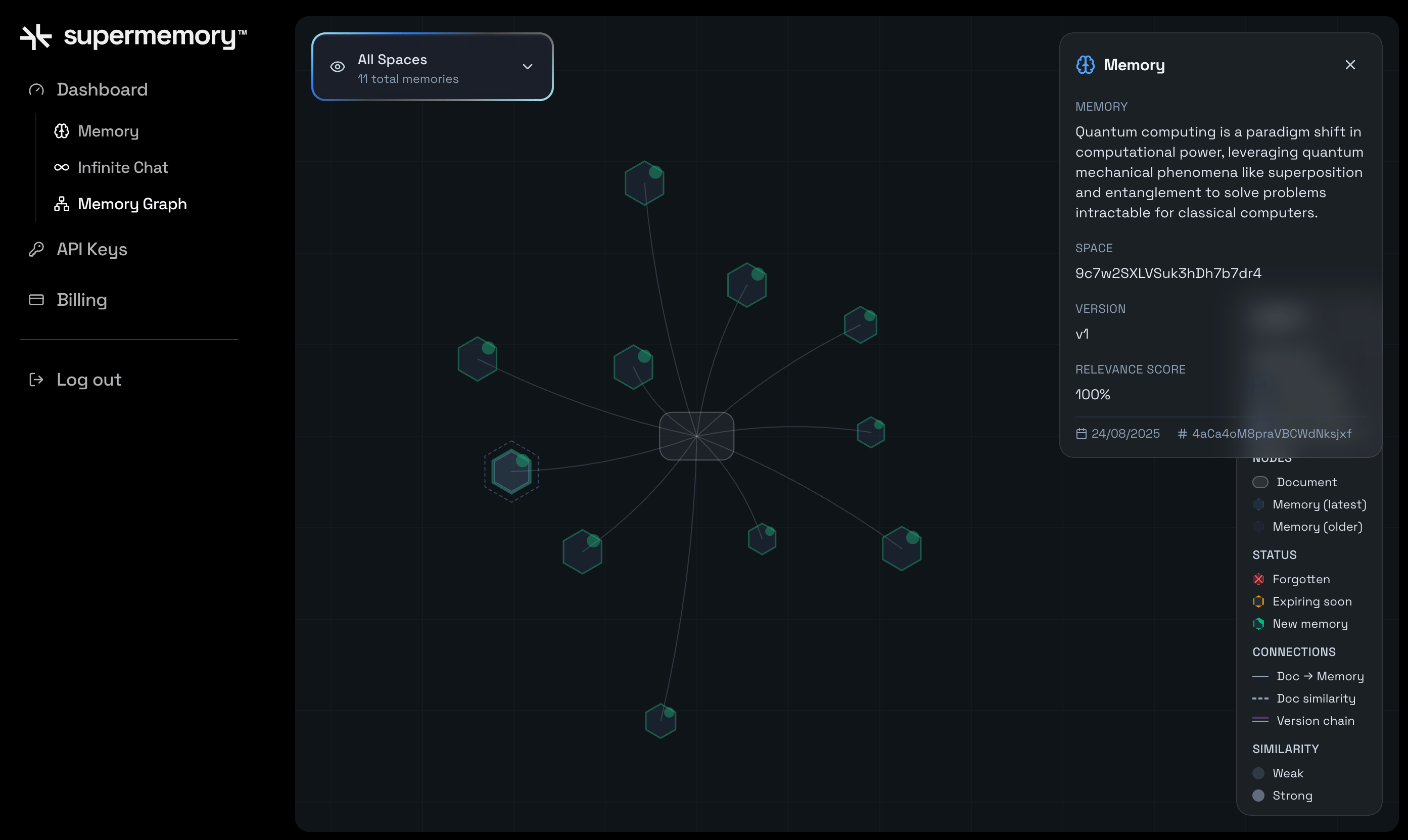 ## The Mental Model
Traditional systems store files. Supermemory creates a living knowledge graph.
* Static files in folders
* No connections between content
* Search matches keywords
* Information stays frozen
* Dynamic knowledge graph
* Rich relationships between memories
* Semantic understanding
* Information evolves and connects
## Documents vs Memories
Understanding this distinction is crucial to using Supermemory effectively.
### Documents: Your Raw Input
Documents are what you provide - the raw materials:
* PDF files you upload
* Web pages you save
* Text you paste
* Images with text
* Videos to transcribe
Think of documents as books you hand to Supermemory. See [Content Types](/concepts/content-types) for the full list of supported formats.
### Memories: Intelligent Knowledge Units
Memories are what Supermemory creates - the understanding:
* Semantic chunks with meaning
* Embedded for similarity search
* Connected through relationships
* Dynamically updated over time
Think of memories as the insights and connections your brain makes after reading those books.
**Key Insight**: When you upload a 50-page PDF, Supermemory doesn't just store it. It breaks it into hundreds of interconnected memories, each understanding its context and relationships to your other knowledge.
## Memory Relationships
## The Mental Model
Traditional systems store files. Supermemory creates a living knowledge graph.
* Static files in folders
* No connections between content
* Search matches keywords
* Information stays frozen
* Dynamic knowledge graph
* Rich relationships between memories
* Semantic understanding
* Information evolves and connects
## Documents vs Memories
Understanding this distinction is crucial to using Supermemory effectively.
### Documents: Your Raw Input
Documents are what you provide - the raw materials:
* PDF files you upload
* Web pages you save
* Text you paste
* Images with text
* Videos to transcribe
Think of documents as books you hand to Supermemory. See [Content Types](/concepts/content-types) for the full list of supported formats.
### Memories: Intelligent Knowledge Units
Memories are what Supermemory creates - the understanding:
* Semantic chunks with meaning
* Embedded for similarity search
* Connected through relationships
* Dynamically updated over time
Think of memories as the insights and connections your brain makes after reading those books.
**Key Insight**: When you upload a 50-page PDF, Supermemory doesn't just store it. It breaks it into hundreds of interconnected memories, each understanding its context and relationships to your other knowledge.
## Memory Relationships
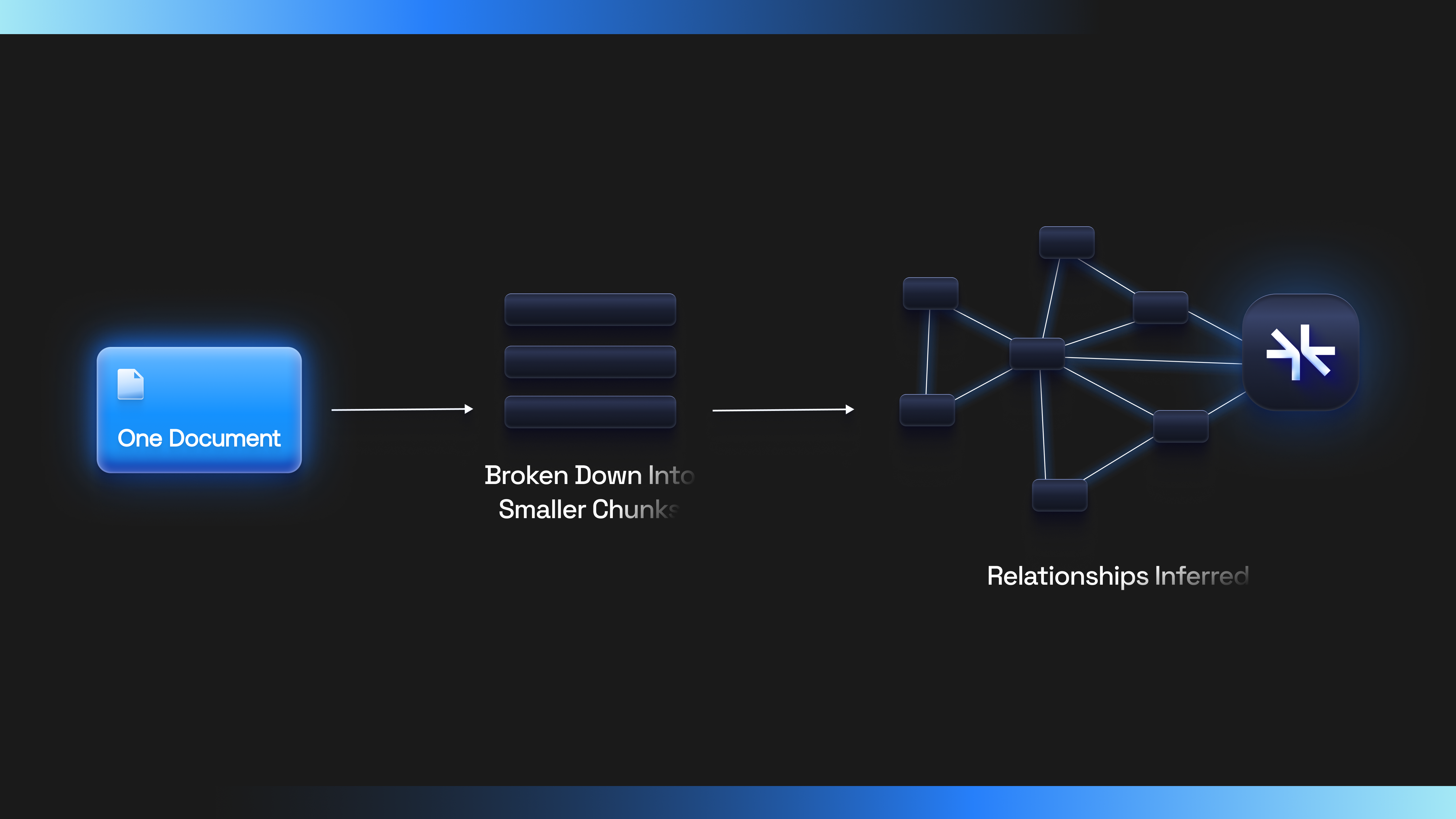 The graph connects memories through three types of relationships. For a deeper dive into how these relationships work, see [Graph Memory](/concepts/graph-memory).
### Updates: Information Changes
When new information contradicts or updates existing knowledge, Supermemory creates an "update" relationship.
```text Original Memory theme={null}
"You work at Supermemory as a content engineer"
```
```text New Memory (Updates Original) theme={null}
"You now work at Supermemory as the CMO"
```
The system tracks which memory is latest with an `isLatest` field, ensuring searches return current information.
### Extends: Information Enriches
When new information adds to existing knowledge without replacing it, Supermemory creates an "extends" relationship.
Continuing our "working at supermemory" analogy, a memory about what you work on would extend the memory about your role given above.
```text Original Memory theme={null}
"You work at Supermemory as the CMO"
```
```text New Memory (Extension) - Separate From Previous theme={null}
"Your work consists of ensuring the docs are up to date, making marketing campaigns, SEO, etc."
```
Both memories remain valid and searchable, providing richer context.
### Derives: Information Infers
The most sophisticated relationship - when Supermemory infers new connections from patterns in your knowledge.
```text Memory 1 theme={null}
"Dhravya is the founder of Supermemory"
```
```text Memory 2 theme={null}
"Dhravya frequently discusses AI and machine learning innovations"
```
```text Derived Memory theme={null}
"Supermemory is likely an AI-focused company"
```
These inferences help surface insights you might not have explicitly stated.
## Processing Pipeline
Understanding the pipeline helps you optimize your usage:
| Stage | What Happens |
| -------------- | --------------------------- |
| **Queued** | Document waiting to process |
| **Extracting** | Content being extracted |
| **Chunking** | Creating memory chunks |
| **Embedding** | Generating vectors |
| **Indexing** | Building relationships |
| **Done** | Fully searchable |
**Tip**: Larger documents and videos take longer. A 100-page PDF might take 1-2 minutes, while a 1-hour video could take 5-10 minutes.
## Next Steps
Now that you understand how Supermemory works:
Start adding content to your knowledge graph
Learn to query your knowledge effectively
The graph connects memories through three types of relationships. For a deeper dive into how these relationships work, see [Graph Memory](/concepts/graph-memory).
### Updates: Information Changes
When new information contradicts or updates existing knowledge, Supermemory creates an "update" relationship.
```text Original Memory theme={null}
"You work at Supermemory as a content engineer"
```
```text New Memory (Updates Original) theme={null}
"You now work at Supermemory as the CMO"
```
The system tracks which memory is latest with an `isLatest` field, ensuring searches return current information.
### Extends: Information Enriches
When new information adds to existing knowledge without replacing it, Supermemory creates an "extends" relationship.
Continuing our "working at supermemory" analogy, a memory about what you work on would extend the memory about your role given above.
```text Original Memory theme={null}
"You work at Supermemory as the CMO"
```
```text New Memory (Extension) - Separate From Previous theme={null}
"Your work consists of ensuring the docs are up to date, making marketing campaigns, SEO, etc."
```
Both memories remain valid and searchable, providing richer context.
### Derives: Information Infers
The most sophisticated relationship - when Supermemory infers new connections from patterns in your knowledge.
```text Memory 1 theme={null}
"Dhravya is the founder of Supermemory"
```
```text Memory 2 theme={null}
"Dhravya frequently discusses AI and machine learning innovations"
```
```text Derived Memory theme={null}
"Supermemory is likely an AI-focused company"
```
These inferences help surface insights you might not have explicitly stated.
## Processing Pipeline
Understanding the pipeline helps you optimize your usage:
| Stage | What Happens |
| -------------- | --------------------------- |
| **Queued** | Document waiting to process |
| **Extracting** | Content being extracted |
| **Chunking** | Creating memory chunks |
| **Embedding** | Generating vectors |
| **Indexing** | Building relationships |
| **Done** | Fully searchable |
**Tip**: Larger documents and videos take longer. A 100-page PDF might take 1-2 minutes, while a 1-hour video could take 5-10 minutes.
## Next Steps
Now that you understand how Supermemory works:
Start adding content to your knowledge graph
Learn to query your knowledge effectively